





Quality management description
Quality evaluation and development is about improving operations and maintaining strengths.
All for the Quality!
1. Introduction
The quality system of South-Eastern Finland University of Applied Sciences (Xamk) includes Xamk’s common quality policy, related responsibilities, and methods and tools for continuous development, providing the framework for our operations and for maintaining and improving their quality. Our quality system follows the Standards and Guidelines for Quality Assurance in the European Higher Education Area (ESG). This is ensured through an audit by the Finnish Education Evaluation Centre (FINEEC).
This quality management description outlines Xamk’s quality management and serves as Xamk’s quality manual.
This description is complemented by:
- Instructions and guidelines on Xamk’s intranet
- Xamk’s process descriptions in the IMS management solutions software
- Description of the evaluation and feedback system on Xamk’s intranet
2. Quality Policy
The general principles and aims of quality management at Xamk are described in our quality policy:
- Management that values qualityQuality work supports Xamk’s strategy and management. Xamk’s management and operational steering are based on information systematically produced by the quality system and on the principle of continuous development. We aim for high quality and impact in all our activities.
- Collective quality cultureEveryone at Xamk is responsible for quality and participates in its development. When developing our operations, we utilise methods that motivate and commit our staff and students to improving quality.
- Transparency, reliability, and communication Xamk’s quality work is guided by the principles of transparency, reliability, and confidentiality. We actively share and communicate the information produced by our quality system.
3. Why does Xamk evaluate and develop quality?
According to our strategy, we work responsibly for a better tomorrow. We aim for high quality and impact in all our activities. Continuous evaluation and development of quality, as well as maintaining our strengths, are vital to achieving this aim.
Under the Universities of Applied Sciences Act (932/2014), Finnish universities of applied sciences are responsible for the quality of their operations and for developing that quality, and must evaluate their education, operations, and their impact. They are also obligated to regularly participate in external evaluation of their operations.
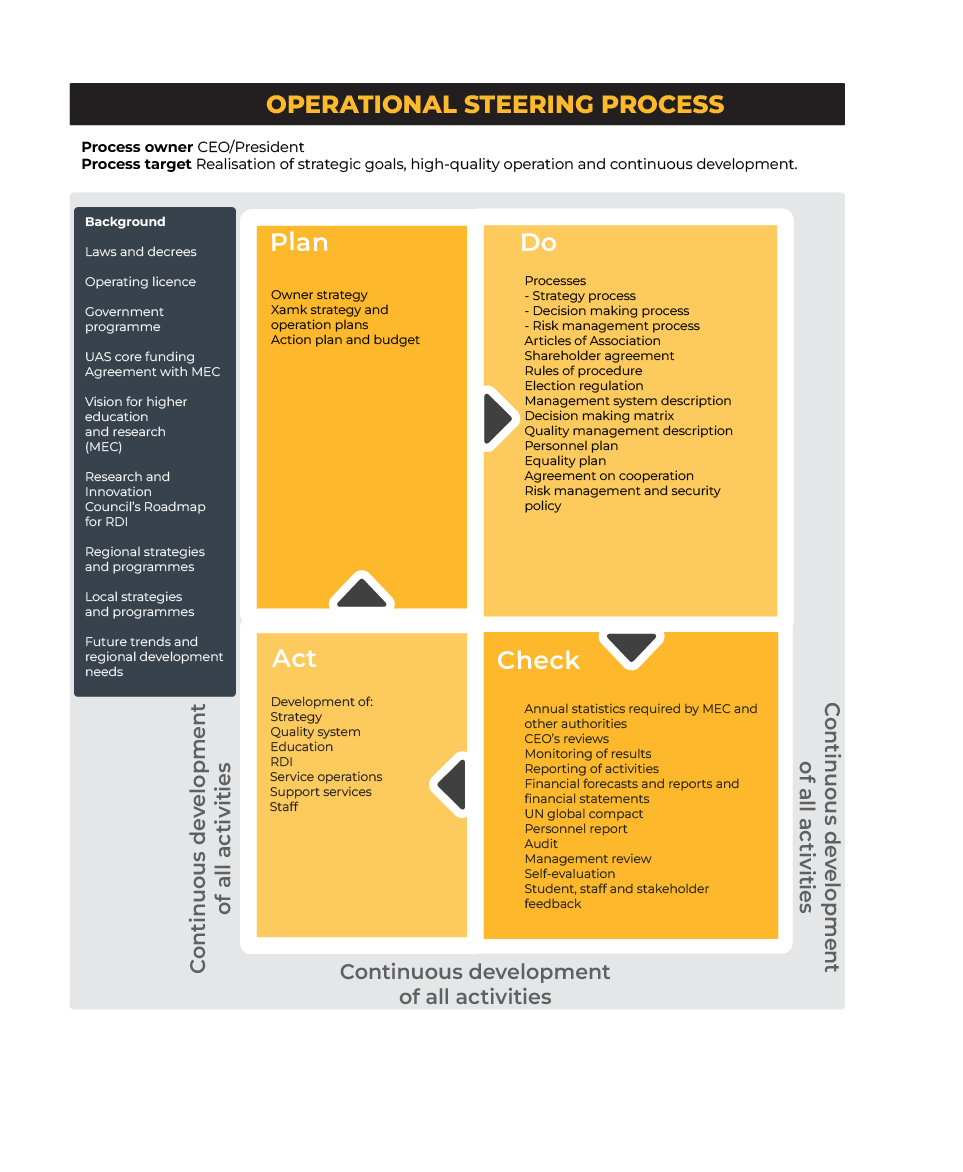
Xamk’s quality system is closely related to its strategic management, being part of Xamk’s operational steering. Through operational steering, we can turn our strategy, goals, and plans into concrete actions and monitor and evaluate the achievement of our goals (see Figure 1). High-quality operations ensure Xamk’s societal impact and provide an important source of competitive advantage.
European Standards and Guidelines (ESG)
Our quality system complies with the European quality assurance recommendations for higher education institutions (HEIs), as set out in the Standards and Guidelines for Quality Assurance in the European Higher Education Area (ESG). Xamk’s quality management applies across all of Xamk’s duties.
Xamk is part of the INGENIUM European University alliance, whose quality assurance framework is also based on the ESG standards and guidelines, as well as its Joint QA Policy. INGENIUM cooperation aims to develop a strong European quality culture and enable the quality assurance of joint degree programmes through transnational collaboration.
The ESG sets out two purposes for higher education institutions’ quality assurance activities: accountability and enhancement. These create trust in the higher education institution’s performance. A successfully implemented quality system will provide information to assure the higher education institution and the public of the quality of the institution’s activities (accountability) as well as provide recommendations on how it might improve what it is doing (enhancement).
ESG has ten standards and guidelines for internal quality assurance, presented in Table 1.
Table 1. ESG standards and guidelines
HEIs should have a policy for quality assurance that is made public and forms part of their strategic management. Internal stakeholders should develop and implement this policy through appropriate structures and processes, while involving external stakeholders.
HEIs should have processes for the design and approval of their programmes. The programmes should be designed to meet the objectives set for them, including the intended learning outcomes. The qualification resulting from a programme should be clearly specified and communicated, and refer to the correct level of the national qualifications framework for higher education and, consequently, to the Framework for Qualifications of the European Higher Education Area.
HEIs should ensure that the programmes are implemented in a way that encourages students to take an active role in creating the learning process, and that the assessment of students reflects this approach.
HEIs should consistently apply pre-defined and published regulations covering all phases of the student “life cycle”, including, for example, student admission, the progress of studies, recognition of previous studies and certification.
HEIs should assure themselves of the competence of their teachers. They should apply fair and transparent processes for staff recruitment and development.
HEIs should have appropriate funding for learning and teaching activities and ensure that adequate and readily accessible learning resources and support for students are provided.
HEIs should ensure that they collect, analyse and use relevant information for the effective management of their programmes and other activities.
HEIs should publish information about their activities, including programmes, which is clear, accurate, objective, up-to-date and readily accessible..
HEIs should monitor and periodically review their programmes to ensure that they achieve the objectives set for them and respond to the needs of students and society. These reviews should lead to continuous improvement of the programmes. Any action planned or taken as a result should be communicated to all those concerned.
HEIs should undergo external quality assurance in line with the ESG on a cyclical basis.
4. Who ensures quality at Xamk?
Xamk’s staff and students as a community are committed to quality work. Everyone at Xamk contributes to ensuring the quality of our activities and to offering high-quality services to our students, staff, and stakeholders. We are all responsible for the quality of our work and actively participate in co-development (Table 2). An active and development-oriented approach to our own and our colleagues’ work is a vital part of our daily activities. We also involve members of our stakeholders in the evaluation and development of our activities. Our quality culture rises from this atmosphere of individual and collective development.
Xamk’s quality culture refers to an environment and atmosphere of long-term development, in which strengths and areas in need of development are actively and deliberately identified, leading to necessary development measures across all levels of the organisation.
Table 2. Quality-related roles and responsibilities at Xamk.
Are committed to Xamk’s common rules and guidelines.
Are responsible for their own learning and study progress.
Have the right to give constructive feedback to develop education and other operations.
Communicates students’ quality responsibilities and possibilities to contribute to Xamk’s quality work.
Responsible for students’ participation in Xamk-level development work:
- Xamk Ltd Board of Directors
- decision-making bodies
- departments’ development forums
working groups
Are committed to Xamk’s values, strategy, and vision, as well as to high-quality, responsible operations.
Are responsible for the quality and continuous development of their own operations, as well as for maintaining and developing their expertise.
Act in accordance with common processes/guidelines.
Have the right and possibility to give and receive constructive feedback to support the development of operations.
Responsible for the following in their unit/area of responsibility:
- familiarising staff with quality management
- operational quality, results, and functionality of quality management
- launching feedback surveys, as well as analysing and communicating the unit’s results
- initiating, monitoring, and evaluating development measures
- documentation related to quality management at the unit level
- functionality and development of stakeholder cooperation
Responsible for familiarising students with their quality responsibilities and Xamk’s quality management.
Organise the response to the arrival survey and processing of the results.
Participate in processing degree programme feedback and handle any necessary further processing.
Responsible for drafting, updating, and developing process descriptions/guidelines in their area of responsibility.
The overall responsibility for the realisation of Xamk’s quality policy by means of Xamk’s quality system. Chair of the quality team.
Together with the quality manager, responsible for:
- Developing Xamk’s quality system
- Coordinating and instructing others on quality management
- Evaluating operations and developing evaluation methods
- Collecting feedback and analysing results
- Documentation related to the quality system
Internal and external communication related to quality management.
Has the overall responsibility for the successful management of Xamk’s duties and the quality and development of all its activities.
Responsible for the strategic guidance of quality work and for launching, monitoring, and evaluating Xamk-level development measures. Is committed to Xamk’s quality work and is responsible for the quality and results of its own fields of operation.
.
Monitors the realisation of Xamk’s strategy and the achievement of the goals set for Xamk.
Participate in the development of Xamk’s education, RDI activities, and service activities, provide feedback, and evaluate operations.
5. What does Xamk’s quallity system consists of?
Xamk’s quality system consists of:
- quality policy
- quality responsibilities
- procedures with which we continuously evaluate and improve our operations.
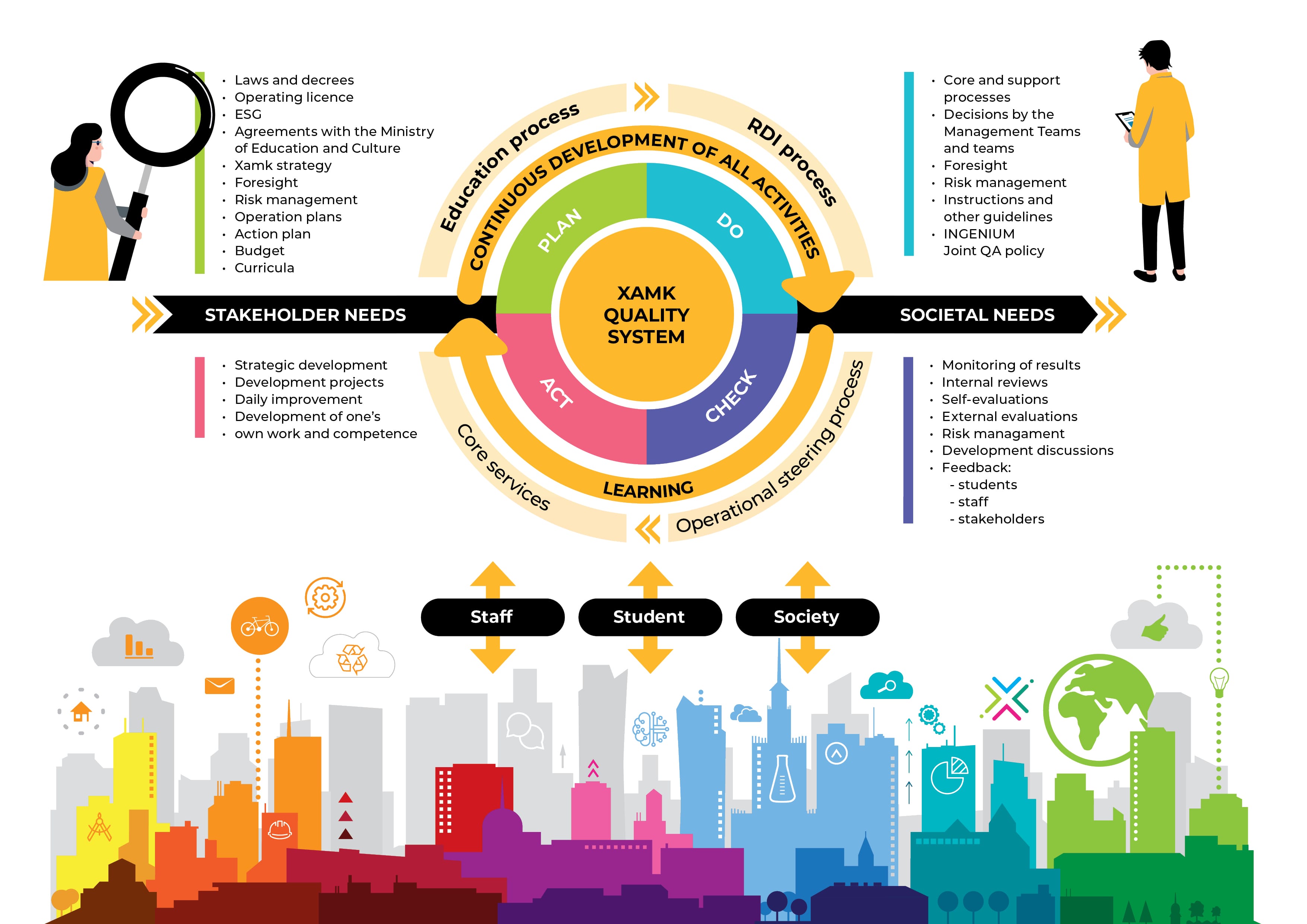
Our quality management is based on the principle of continuous development, following the PDCA method, where Plan, Do, Check, and Act form an iterative cycle. The quality system allows Xamk to implement its quality policy, promote the development of operations and competence, and ensure the utilisation of evaluation and feedback data.
The aims of the Xamk quality system are to:
- systematically produce information to support management and development
- support the quality assurance of Xamk’s operations
- ensure that information is used to support development on all levels of the organisation
- clarify and standardise the responsibilities of all actors in quality management
- standardise practices and spread good approaches
- support the participation of members of the Xamk community – students, staff, and stakeholders – in developing operations
- strengthen the quality culture and the atmosphere of continuous development
- maintain and promote transparency, reliability, and confidentiality.
Planning
Xamk’s operations and quality management are guided by its strategy. Xamk’s strategy is developed under the supervision of the Xamk Board, in consultation with Xamk’s management, staff, student union, and stakeholders. It is updated as needed based on changes in the operating environment, foresight information, and evaluation of development measures. Strategic policy definitions are included annually in Xamk’s action plans and budgets, as well as in those of its departments. Plans to complement and specify the strategy are drafted if necessary.
The basis for operational planning at Xamk is meeting the goals that we have set and ensuring the continuity of our operations, which is part of our risk management. We can ensure the success of our operations by regularly monitoring our results. This also enables us to take corrective measures at the right time.
Implementation
Our daily operations are guided by recognised processes with clear descriptions, decisions by the management teams and working groups, and various guidelines and instructions. Through harmonised operating methods, we ensure that our operations are responsible, sustainable, and consistently high-quality, and that identified risks are managed and anticipated.
Evaluation
At the evaluation stage, the direction and results of our operations are monitored and evaluated. Involving students, staff, and stakeholders in the evaluation of operations promotes commitment and possibilities to influence. The data from our evaluation and feedback system, together with the monitoring of results, play a key role in steering operational development at all levels of the organisation.
Development and learning
Our operations are developed systematically. This development is based on foresight, internal and external evaluation and feedback data, as well as the goals set by the strategy and other plans guiding our operations.
Development work is conducted as externally funded RDI or non-RDI projects, self-funded development projects, and as part of the normal continuous development of operations. We identify and analyse development needs, agree on development targets, monitor our progress, and present and share our results in, for example:
- meetings of various bodies
- unit meetings, development days, and drafting of the annual budget and action plans
- management reviews
- staff and students’ joint development forums
- self-evaluations
- development project reporting and evaluations.
Development is also part of everyone’s own work; it can be minor improvements or experiments in everyday work that do not require specific plans or resource allocation. We encourage our staff to develop new ideas and initiatives.
Competence development and learning are essential tools for our overall development. We promote the development of our staff’s competence through joint competence development methods.
6. How and what methods are used to develop operations?
The development of Xamk’s quality system and its various aspects follows the Plan-Do-Check-Act principle of continuous development. We use common methods to maintain, evaluate, and improve quality, which are integrated into our quality system.
Processes
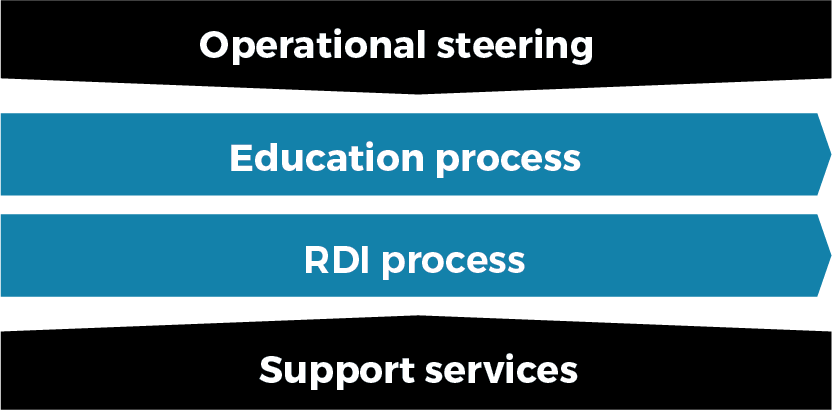
Our core processes are education and RDI. Our support processes comprise operational steering and support services, which facilitate the successful execution of the core processes and support our operations (Figure 3). Both core and support processes are divided into sub-processes, and these processes are described in the IMS system in accordance with the process description instructions. Process descriptions promote the functionality of our operations, the achievement of our goals, and the satisfaction of customer needs. They also clarify and harmonise our operations.
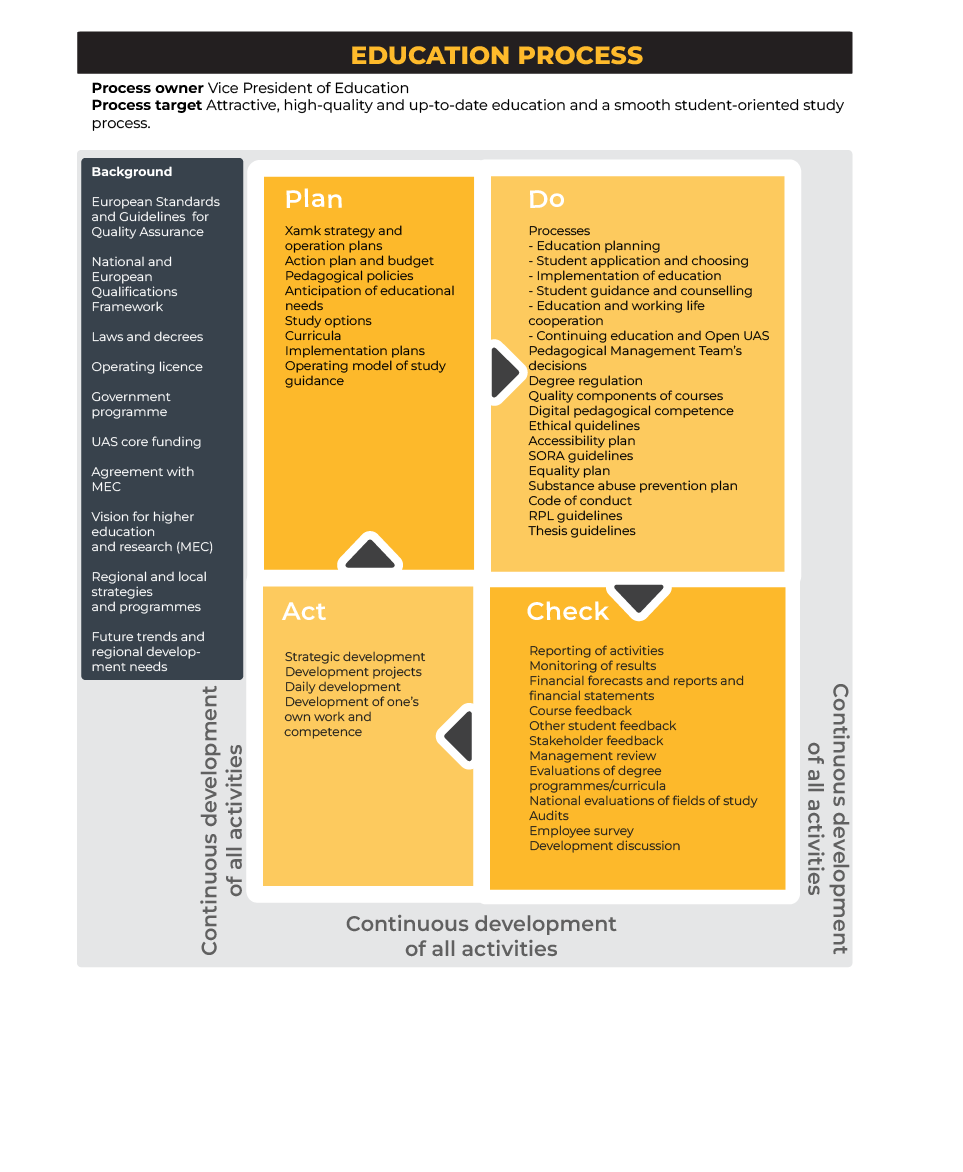
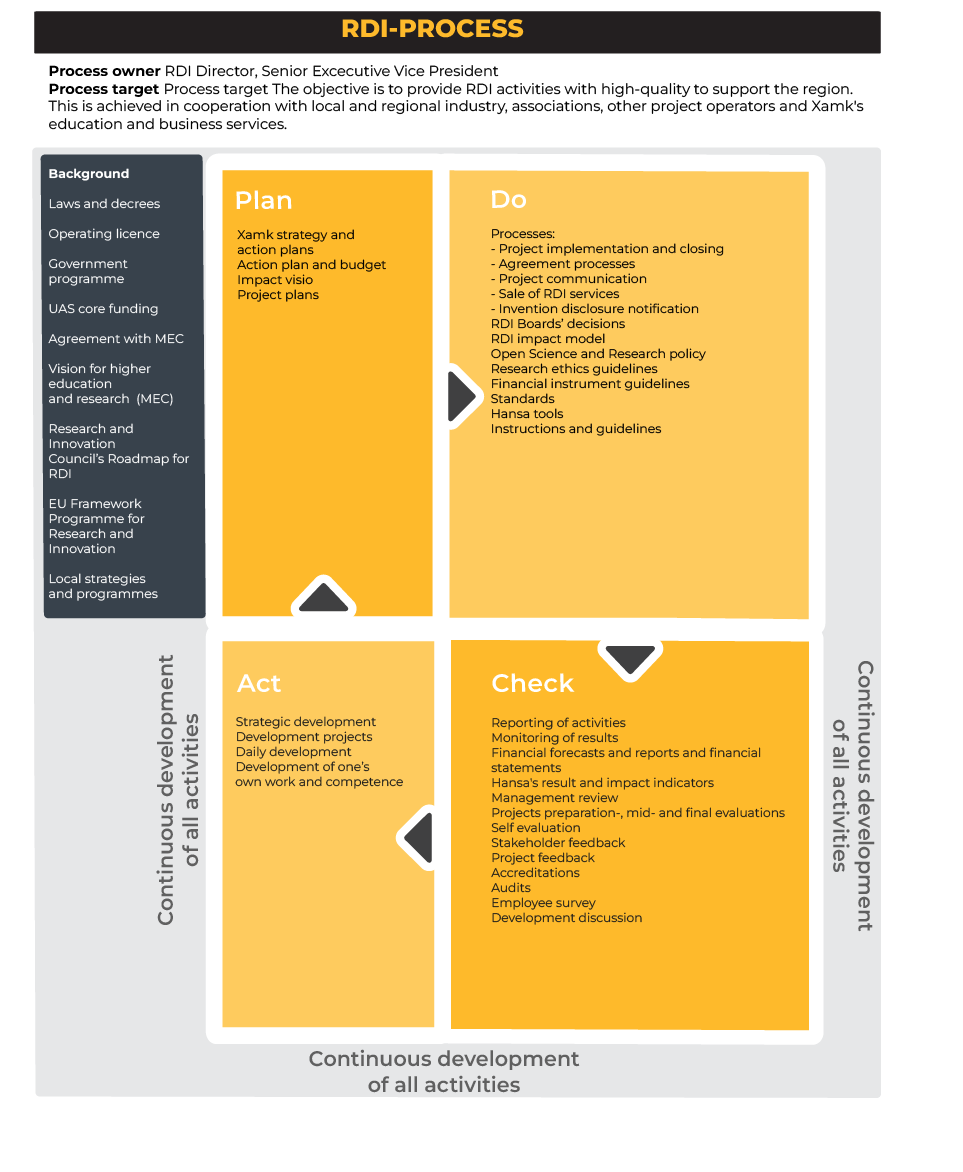
Quality management of education and RDI activities
The images below (Figures 4 and 6) illustrate the quality management methods for education and RDI activities. The processes are based on the principle of continuous development, and each has a designated owner and target.
Guidelines and instructions
Our operations include areas where it is appropriate to have guidelines or instructions to further specify these activities. Some of these are statutory (Degree Regulations and SORA instructions), and others are deemed necessary by Xamk to ensure the quality and functionality of our operations. These instructions are binding for the entire Xamk community. Instructions and guidelines refer to those with a broader application than a single working duty or manual, such as a common operating method that applies to the entire Xamk community.
These are saved in the case management system and are available on Xamk’s intranet on the page of the relevant topic or activity. They are drafted in accordance with common instructions.
Evaluation and feedback
Xamk’s evaluation and feedback system promotes its strategic goals by providing a systematic and comprehensive way to collect, analyse, and use feedback from different target groups (Figure 6).
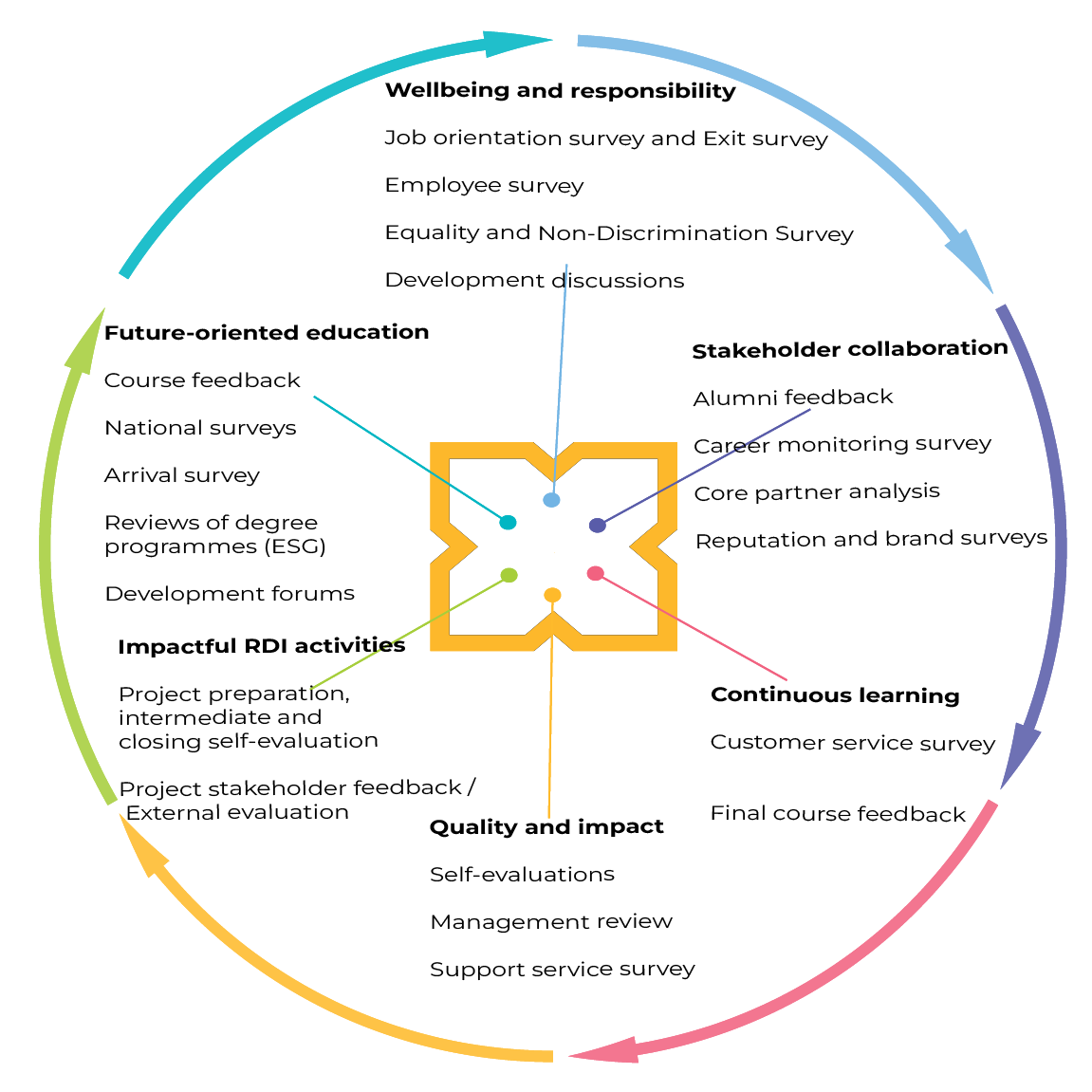
Evaluation that encompasses Xamk’s entire operating environment, combined with regular feedback collection, yields reliable, diverse feedback data that offers perspectives for developing operations and supporting decision-making. The system promotes continuous development, student-orientation, staff wellbeing, and stakeholder cooperation.
Surveys targeted at students and stakeholders include both Xamk’s internal feedback surveys and national feedback surveys. Feedback collection is approved annually, including the target group, collection method, timing, collection and analysis responsibilities, and the initiation of development measures for each.
Feedback results are processed transparently, ensuring confidentiality and data protection. Students receive feedback-on-feedback, i.e., information about the feedback provided and the possible measures it has led to.
Monitoring of results
Monitoring of results includes the operative goals, indicators, and their moni-toring, set annually by the Management Team. Our strategic goals are long-er-term goals that highlight the impact of our institution in its area of opera-tions. Goals and indicators are typically set when the strategy is updated. The Management Team monitors the achievement of our goals.
Internal reviews
The annual management reviews bring together staff, student representatives, and unit management to examine themes of strategic importance. The purpose of these reviews is to:
- evaluate operations
- support and promote self-guided development work
- promote the implementation of the strategy.
The reviews address our strategic direction, set goals, the measures taken to achieve them, and accomplishments and results. They also aim to identify development targets for achieving our strategic goals.
Other reviews on different themes can also be conducted.
Self-evaluations
RDI projects conduct self-evaluation throughout their entire lifecycle, typically through the Hansa system.
In educational development, continuous evaluation is integrated into degree programme planning, implementation, and development, such as the curriculum process and pedagogical development. Changes to the study opportunities available and new degree programmes are handled through a common process. The curriculum development and update process includes self-evaluations and peer evaluations of degree programmes. Evaluations follow the Standards and Guidelines for Quality Assurance in the European Higher Education Area (ESG).
A self-evaluation of the quality system is done every third year. This is always done as part of an external audit.
External evaluations and audits of the quality system
An audit is an independent and systematic external evaluation. Xamk participates in national educational field-specific or theme-specific evaluations and other necessary field-specific or degree programme-specific evaluations (e.g., Degree Programme in Marine Engineering). Our accredited laboratories go through regular external evaluation.
Xamk’s quality system is audited regularly. Finnish higher education institutions are audited by the Finnish Education Evaluation Centre (FINEEC). This audit is conducted every six years and evaluates all activities of the higher education institution. FINEEC publishes the evaluation criteria and the methods for implementing audits in its audit manual. Passing the audit means that our quality systems meet both national and European quality assurance criteria. As an audited higher education institution, Xamk receives a quality label and is included in FINEEC’s registry of such institutions.
Staff feedback and development discussions
Feedback is widely collected from staff at different stages of their careers to support the continuous development of operations. Our success depends on how our community members succeed, achieve their goals, and cooperate.
The annual development discussions aim to:
- evaluate work performance and results
- clarify the employee’s job description and role
- give mutual feedback
- define the goals and targets of work
- identify development needs and agree on related measures
- promote cooperation and a positive work atmosphere.
Student feedback and development forums
Students are involved in giving feedback several times during their studies. Student feedback is used to develop and evaluate Xamk’s student-centred activities and services.
Development forums are joint events between students, staff, and the student union, organised by departments at least once per academic year. Development forums
- provide a possibility for students to influence the development of education
- build our community and promote interaction between students and staff
- are an interactive way to process student feedback and co-develop concrete actions to achieve desired changes
- are a possibility to discuss a theme relevant to students’ studies together and ponder on its influence on studies and work.
7. Where are we heading
We develop our quality system in accordance with the principle of continuous development. The participation of students, staff, and stakeholders and the utilisation of their feedback and ideas are an integral part of this development work. Everyone at Xamk is responsible for the quality of our operations and for developing it. By building an active, participatory, and open atmosphere, we lay the foundation for high-quality operations.
Xamk’s Quality Team and Quality Services are responsible for developing its quality system.
We aim for a quality system that:
- is dynamic and proactive
- supports our strategy and the development of our operations
- ensures high quality and impact
- improves and clarifies operations through a system of processes and instructions
- promotes a participatory, transparent, and interactive quality culture.
Muutosluettelo
- Quality Team 14 December 2016
- Changed: Stakeholder and alumni feedback is collected through surveys every 3–5 years annually.
- Added: Surveys can be targeted separately at education, RDI activities, and service operations.
- Quality Team 12 December 2017 – Entire material
- Changed: Updates caused by, among others, Karvi’s Audit Manual 2018–2024, Xamk’s Strategy 2018–2030, and the improved course feedback system.
- Quality Manager 5 July 2019 – Entire material
- Quality Team 25 September 2019 – Entire material
- Quality Manager 22 November 2021
- Changed: Core processes education and RDI. Operational management support process. Changed name: Evaluation and feedback system. Equality and non-discrimination plan every other year.
- Quality Manager 1 January 2023
- Updated student representative responsibilities, images, section Development and Learning. Term “Performance monitoring and measurement plan” changed to “Feedback and evaluation system.” Reviews: removed mention of CAF self-assessment model. Updated evaluation and feedback system.
- Quality Services 10 March 2025
- Updated quality policy: The quality system and its produced information are documented in staff and student introductions and on the website according to user group needs. Information produced by the quality system is shared according to user group needs. Reformulated obligation based on the Universities of Applied Sciences Act.
- Service and Administration Management Team 19 September 2025 – Entire material
Would you like more information? Contact our experts.