




Local development spiced with a global touch
The drive for development came from Iisalmi Food Services’ new Food Service Manager, Janne Maksimainen, and Food Service Supervisor, Anne-Helena Sutinen. Their needs were addressed through the Enabling Program’s action Increasing Food Waste Awareness, as the food services aimed to improve food waste management.
The final year of the three-year international KISMET – Sustainable Food Environments project enabled collaboration with Iisalmi Food Services, which joined as a friendship city when the initiative was rolled out across various countries in the Baltic Sea region.
Creating the Action Plan
The long-term goal of Iisalmi Food Services is to reduce plate waste from compulsory students’ meals. However, it was considered equally important to ensure that students eat school meals regularly. After a quick initial assessment, we decided to develop an action plan for Iisalmi Food Services to raise awareness of food waste among compulsory students.
The aim of the action plan is to increase awareness of food waste; why it should be reduced and to enhance young people’s appreciation of school meals. It is essential for students to understand the importance of nutrition for their growth and well-being. Together, these factors also influence plate waste in Iisalmi Food Services.
The framework for the action plan was based on the KISMET Sustainable Food Environments and Food Circularity programme.
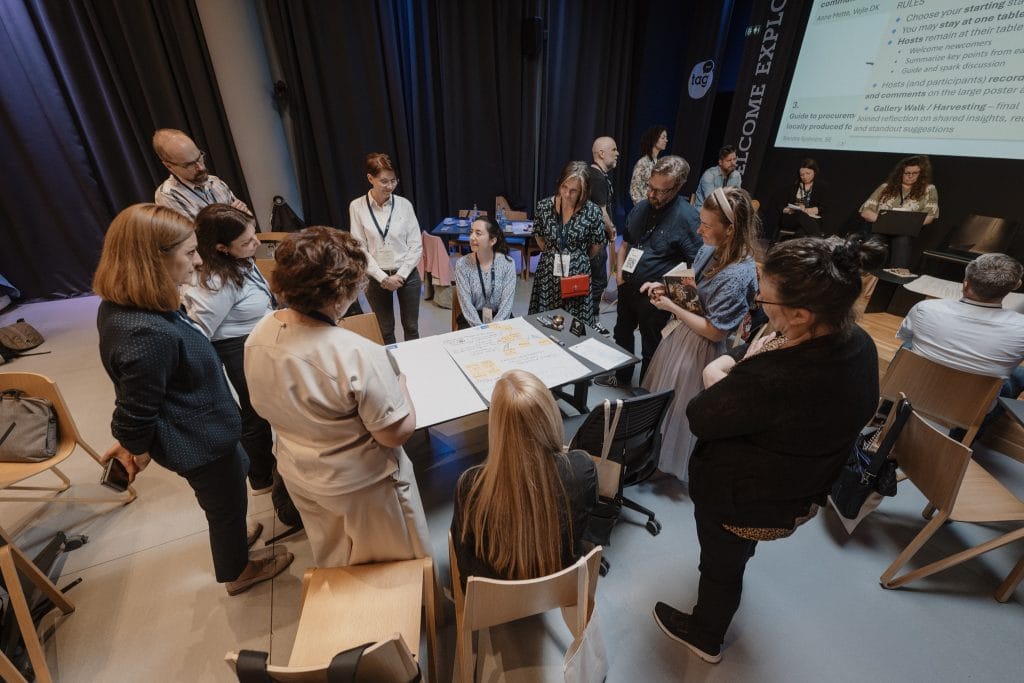
Three online meetings were organized for representatives of all eight KISMET friendship cities. In addition, the entire KISMET community worked on various themes related to sustainable food systems during two meetings held in Vilnius and Savonlinna.
For the action plan, five joint development workshops were conducted with Iisalmi Food Services. Each workshop began with a theoretical session on the theme of food waste, followed by collaborative work with participants to design concrete measures.
In addition to these measures, supplementary material was compiled for the action plan to support Iisalmi Food Services’ efforts. This included resources from various Finnish sources, such as previous food waste reduction projects and publications by the Sustainable Food Services Research Unit.
A Practical Tool as a Result
The action plan focuses on three themes to improve food waste management: food education, communication, and customer collaboration. It is structured around theoretical sections for each theme, complemented by ideas and suggestions for practical measures. In addition, the plan includes existing tools for food waste management, which Iisalmi Food Services can adopt as needed.
The established framework provided a solid foundation for building the action plan.
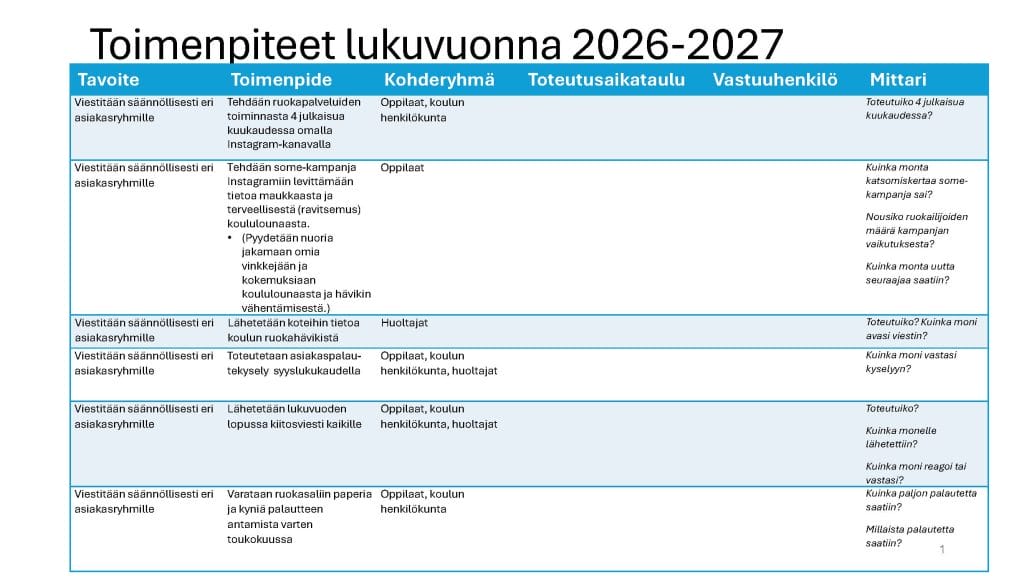
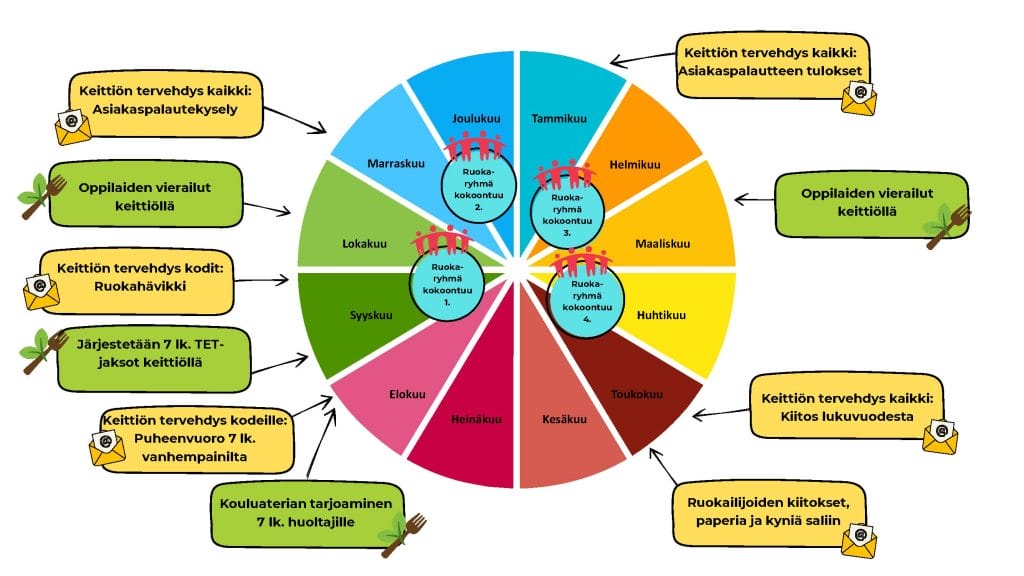
Furthermore, the plan outlines practical measures (see image below) to raise food waste awareness among students during the academic years 2026–2028 within Iisalmi Food Services.
The measures are organized under the following themes:
- Food Education: Actions and methods to promote food waste awareness through food education.
- Communication: Communication strategies and tools to increase awareness of food waste.
- Customer Collaboration: Approaches and methods to strengthen cooperation with customers in reducing food waste.
What’s Next?
The completed action plan has now been handed over to Iisalmi City Food Services, marking the end of the active collaboration phase. The actual implementation of practical measures will begin in January 2026. We look forward to seeing how the development actions are put into practice during spring 2026 and will hear the first updates in May at the initial follow-up meeting.
Over the course of this year-long collaboration, we have built networks across borders and shared experiences on topics such as food waste management with other regions.
This cooperation generates valuable insights and experiences that benefit not only local operations but also the development of the entire sector. We hope this is just the beginning and that collaboration will continue and deepen in the future. We also invite other industry actors to join us boldly in international cooperation!
Learn more:
KISMET – Sustainable Food Environments & Circular Food Systems
Top photo: Kismet project


The authors work at the Sustainable Food Services Research Unit at South-Eastern Finland University of Applied Sciences.
This article is published as part of the KISMET – Sustainable Food Environments project. The project focused on developing more sustainable food environments in collaboration with 13 international partners. The project period was from January 1, 2023, to December 31, 2025. The project received co-funding from the European Union under the Interreg Baltic Sea Region Program.
Microsoft Copilot was used to support the English translation of this article.
Also check out these articles

How to Combine Adult Studies with Everyday Life
Learning Business by Doing: How Digital International Business at Xamk Prepares Students for Real-World Challenges